
The Access Gap: Why Every Healthcare Solution Depends on Fixing the Front Door First

Download the Research Report

A cross-sector analysis of why access, not investment, is the constraint every other healthcare fix runs into.
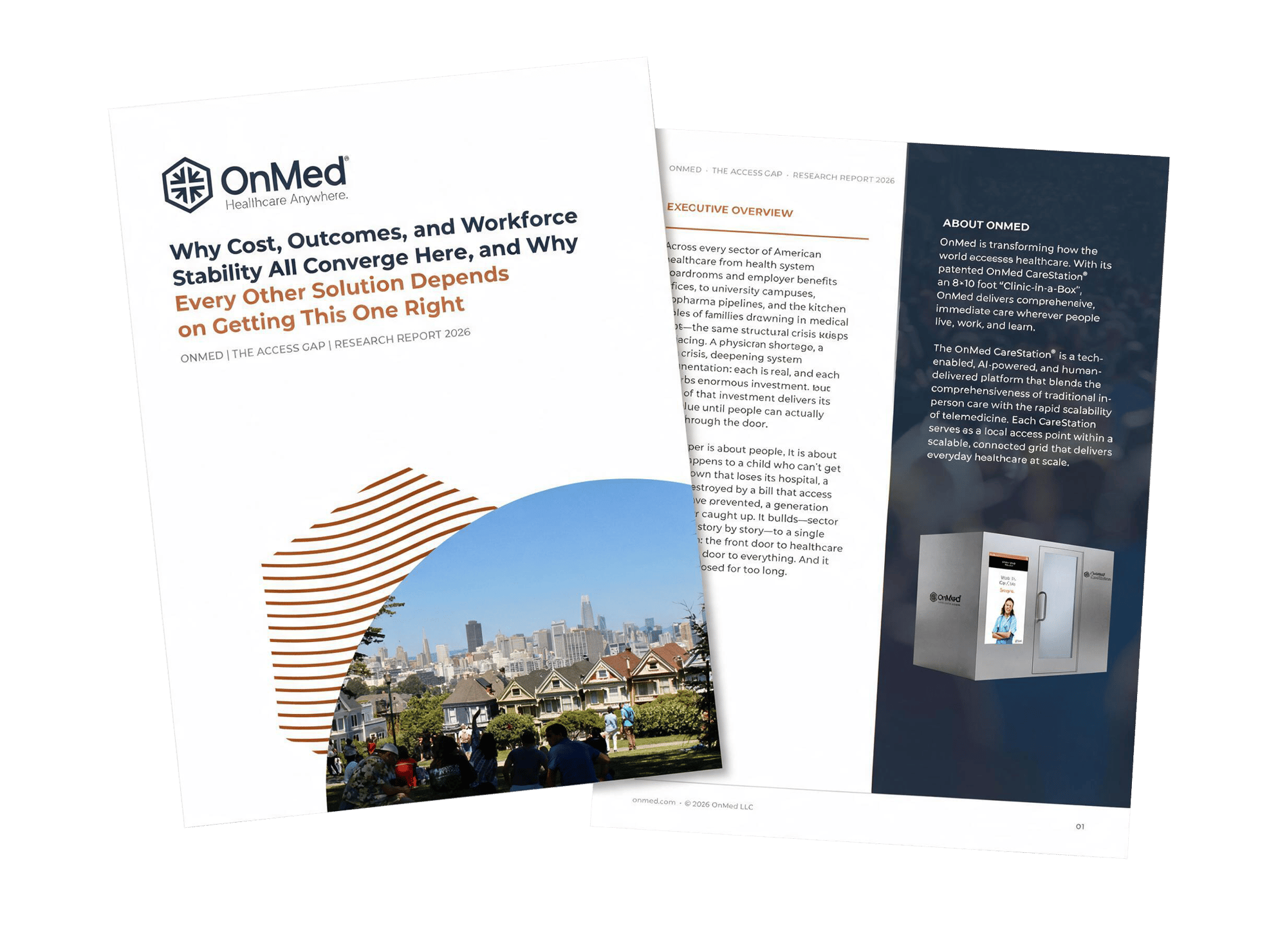
OnMed Access Gap report spread showing the executive overview, About OnMed section, and CareStation kiosk photo.

America spends more than $4.8 trillion a year on healthcare. And 120 million people—one in three—still can't get through the door.

This report doesn't argue for a policy fix. It traces one structural failure across nine sectors: employers, providers, payors, universities, K–12 schools, biopharma, chronic disease, medical debt, and health deserts. In every one, the same pattern holds—when people can't access care early, costs escalate, outcomes worsen, and every other investment in the system delivers less than it should.

What the Report Covers


• Why traditional fixes—brick-and-mortar clinics, telehealth, outsourced care—hit structural limits that no additional investment resolves

• A sector-by-sector breakdown of how the access gap compounds cost and risk: for employers, providers, payors, higher ed, K–12, and biopharma

• The cost cascade: how a $25 problem becomes a $5,000 one when access is delayed

• Outcomes data from deployed CareStation environments: 86% of patients fully diagnosed and treated without escalation, 80% with no prior primary care provider, 37% voluntary return rate

• What a scalable, diagnostically capable front door actually requires to close the gap